
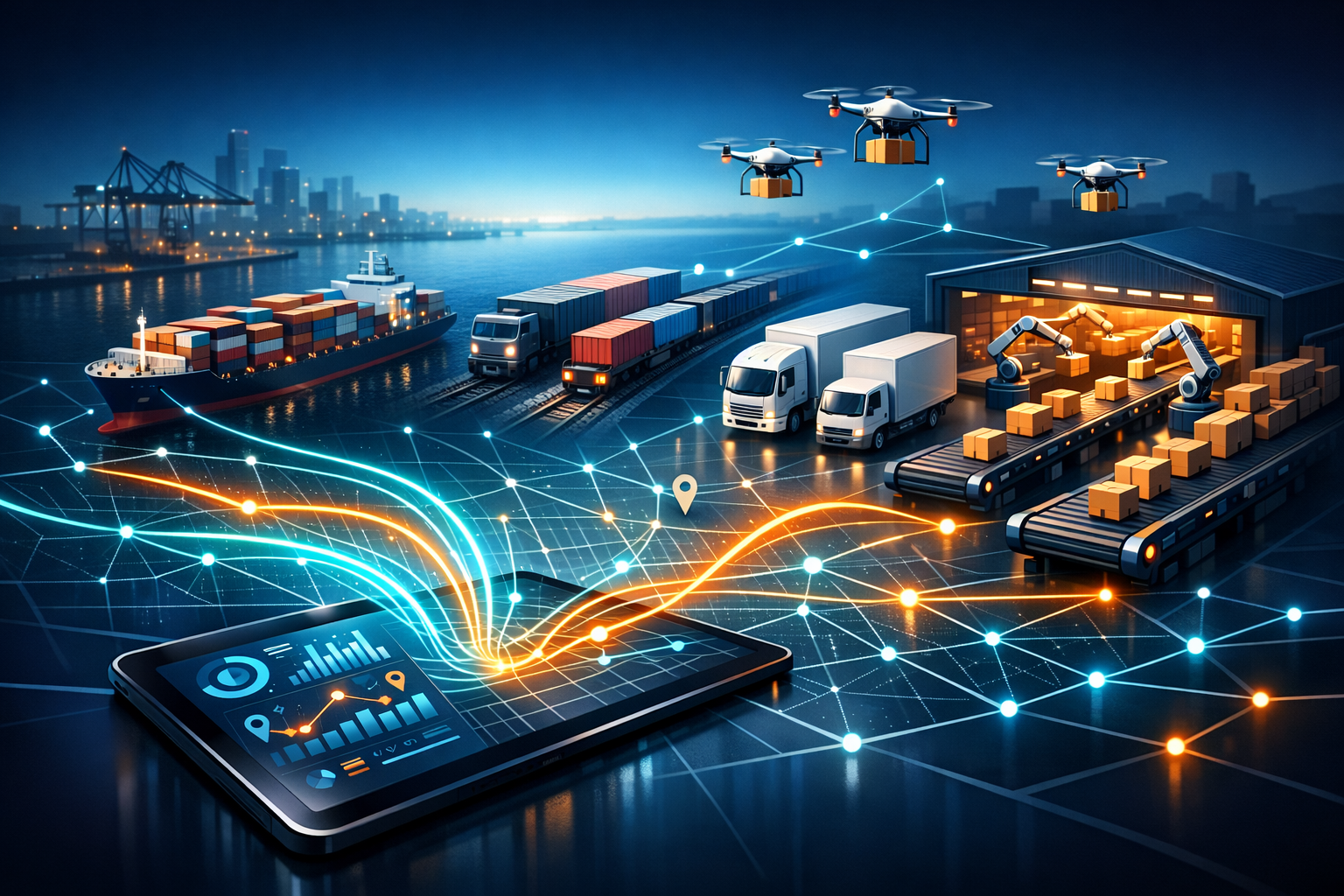
AI in Logistics Apps: 7 Ways to Cut Costs and Boost On-Time Delivery
I once watched a dispatcher do the kind of mental gymnastics that should qualify as a sport. One screen had yesterday’s missed deliveries. Another had a driver calling in about a flat tyre. A third had a customer asking—politely, at first—where their pallet had got to.
There was also a whiteboard. Of course there was. The whiteboard was meant to be the “source of truth”, but it was already out of date… because reality doesn’t wait for dry-erase markers.
If you’re building a logistics app (or trying to rescue the one you’ve already got), that scene probably feels familiar. And this is where AI in logistics actually earns its keep—not as some grand futuristic thing, but as a way to stop your operation being held together by heroic humans and half-accurate spreadsheets.
Here are seven practical ways AI in logistics apps can cut costs and improve on-time delivery—without turning your team into data scientists or your app into an overcomplicated science project.
1) Demand forecasting that doesn’t just repeat last year
Most “forecasting” I see in the wild is basically: last month + vibes. Sometimes with a seasonal adjustment if someone remembers Easter exists.
AI demand forecasting is useful because it can pull in more signals than a human can juggle. Order history, promotions, customer behaviour, weather, holidays, regional trends—whatever you’ve got. It won’t be perfect (nothing is), but it’s usually less wrong in the ways that hurt.
In an app, the win isn’t just a fancy chart. It’s decisions: how many vehicles you’ll need next week, whether to pre-position inventory, which lanes are about to get spicy, and where you can safely run lean.
- Cost cut: fewer emergency shipments, less overtime, less “we ran out so we paid through the nose”.
- On-time boost: fewer last-minute scrambles that blow up schedules.
If you’re starting from scratch, begin with a simple model and a clear feedback loop. Forecast. Compare to reality. Retrain. Repeat. The boring bit is the valuable bit.
2) Smarter shipment planning (the “best carrier at the best price” problem)
Choosing carriers sounds straightforward until you try to do it at scale. Rates change. Capacity disappears. A carrier that’s brilliant on one lane is a mess on another. And everyone’s “on-time performance” report somehow looks amazing… funny, that.
AI can help your logistics app score options based on what actually matters to you: price, predicted transit time, damage rates, claims history, cancellation risk, even how often a lane gets disrupted. The trick is using your own data, not just what someone tells you in a PDF.
This is one of those areas where a little intelligence goes a long way. If your app can recommend a carrier with a realistic ETA and a probability of being late, planners stop gambling and start choosing.
- Cost cut: fewer premium upgrades, fewer chargebacks, fewer “we picked the cheap one and paid for it later”.
- On-time boost: better carrier fit per lane, fewer surprise delays.
One practical move: store lane-level performance metrics in your app. Not just averages. Variance matters. A carrier that’s sometimes fast and sometimes awful is harder to plan around than one that’s reliably decent.
3) Route optimisation that respects the real world
Route optimisation has been around forever, and it’s still weirdly easy to get wrong. The “shortest path” isn’t the best route if the dock only accepts deliveries between 10 and 2, the driver has a break requirement, and the city centre turns into a car park at 4pm.
AI route optimisation earns its place when it uses live and historical data to predict travel times, not just calculate distances. It can also re-optimise mid-day when things go sideways—which, let’s be honest, is most days.
In logistics apps, I like route optimisation features that give planners control. Suggestions, not diktats. Let people override, but capture the reason. That “reason” data becomes gold later.
- Cost cut: fewer miles, less fuel, less wasted driver time.
- On-time boost: better ETAs, fewer late arrivals caused by predictable congestion.
Also: don’t pretend you can optimise without good address data. If your app doesn’t validate addresses and geocodes properly, you’re basically doing maths on sand.
4) Visibility that’s more than a blinking dot on a map
Customers don’t actually want a map. They want certainty. Or, failing that, honesty.
AI-powered logistics visibility is about predicting what’s going to happen next. “Your driver is here” is fine. “Your delivery is likely to be 37 minutes late because of an accident on the A14, and we’ve already rerouted” is better. It lowers inbound calls and stops your team being the human buffer between reality and expectations.
Good apps combine GPS, telematics, traffic, weather, and historical patterns to forecast ETAs and flag risk early. Not when the driver is already late—when they’re about to be late.
- Cost cut: fewer support tickets, fewer failed delivery attempts, less time spent chasing updates.
- On-time boost: earlier interventions, fewer missed time windows.
If you’re building this, think in “exceptions”. Most shipments are boring. Your app should spotlight the few that need attention, not drown people in noise.
5) Warehouse optimisation (where minutes go to disappear)
Warehouses are where good plans go to get delayed by a missing pallet, a jammed printer, or a picker who’s been sent on a scavenger hunt across three aisles.
AI in warehouse operations can help with slotting (where items should live), pick path optimisation, labour planning, and even predicting when inbound congestion will hit. If your logistics app touches warehousing, this is a big lever.
The best results usually come from small changes that compound. Move fast-moving items closer. Reduce travel time. Smooth receiving schedules. Make replenishment less reactive.
- Cost cut: fewer labour hours wasted on walking and searching, less overtime in peak weeks.
- On-time boost: faster pick/pack, fewer late departures from the warehouse.
A simple but overlooked feature: a “confidence score” on inventory accuracy. If the app thinks a location is unreliable, it can prompt a cycle count before it becomes a last-minute panic.
6) Predictive maintenance that stops the domino effect
A vehicle breaking down isn’t just a repair bill. It’s missed deliveries, a driver stuck on the shoulder, customers ringing, and someone trying to reshuffle routes like it’s a magic trick.
Predictive maintenance uses sensor data and service history to flag issues before they become failures. Tyres, brakes, engine anomalies, refrigeration units—especially refrigeration units. Cold chain problems are expensive in ways that make you wince.
In an app, maintenance AI works best when it’s tied directly to scheduling. If a truck is likely to need attention in the next 500 miles, don’t assign it to your most time-sensitive route. That’s not clever. That’s tempting fate.
- Cost cut: fewer roadside callouts, fewer catastrophic failures, longer asset life.
- On-time boost: fewer breakdown-driven delays, more reliable fleet availability.
One note from experience: maintenance teams hate “black box” alerts. Give them the evidence—trend lines, fault codes, what changed—so it feels like help, not finger-pointing.
7) Intelligent document processing (the unglamorous money printer)
If you want a quiet budget win, look at paperwork. Bills of lading, proof of delivery, customs forms, invoices, accessorial charges. It’s a jungle of PDFs, photos, email attachments, and “we’ll send it later”.
Intelligent document processing uses OCR and AI to extract data, match it to shipments, and flag exceptions. It can spot when an invoice doesn’t match the agreed rate, or when a POD is missing a signature, or when a delivery time stamp looks… creative.
This is the bit nobody puts on a conference slide, but it saves real money. It also speeds up billing, which improves cash flow—another topic that’s somehow always urgent.
- Cost cut: fewer overpayments, less manual admin, fewer disputes that drag on for weeks.
- On-time boost: faster exception resolution, fewer holds caused by missing documents.
If you’re adding this to a logistics app, build in human review for edge cases. AI can do 80–90% cleanly. The last 10% is where the weird stuff lives.
A quick word on implementation (before reality bites)
I’ve seen AI projects fail for painfully ordinary reasons: messy data, unclear ownership, and trying to automate a process that’s already broken. AI doesn’t fix chaos. It just scales it.
Start with one workflow you can measure end-to-end. Define what “better” means—lower cost per stop, fewer late deliveries, fewer failed attempts, reduced detention, whatever matters. Then instrument your app so you can actually see the impact.
And please—keep humans in the loop. Not because AI is scary, but because logistics is full of context. Roadworks. A customer with a grumpy security guard. A dock that “closes at 5” but stops unloading at 4:30 if the supervisor wants to go home.
The best AI in logistics apps feels like a calm co-pilot. It notices patterns, suggests options, and gives you early warning. It doesn’t pretend it can run the whole show.
Because the show is messy. Always has been. The goal isn’t perfection. It’s fewer surprises… and the kind of on-time delivery that doesn’t require a whiteboard and a small miracle.