
AI in Agriculture Apps: Precision Farming to Boost Yields & Cut Costs
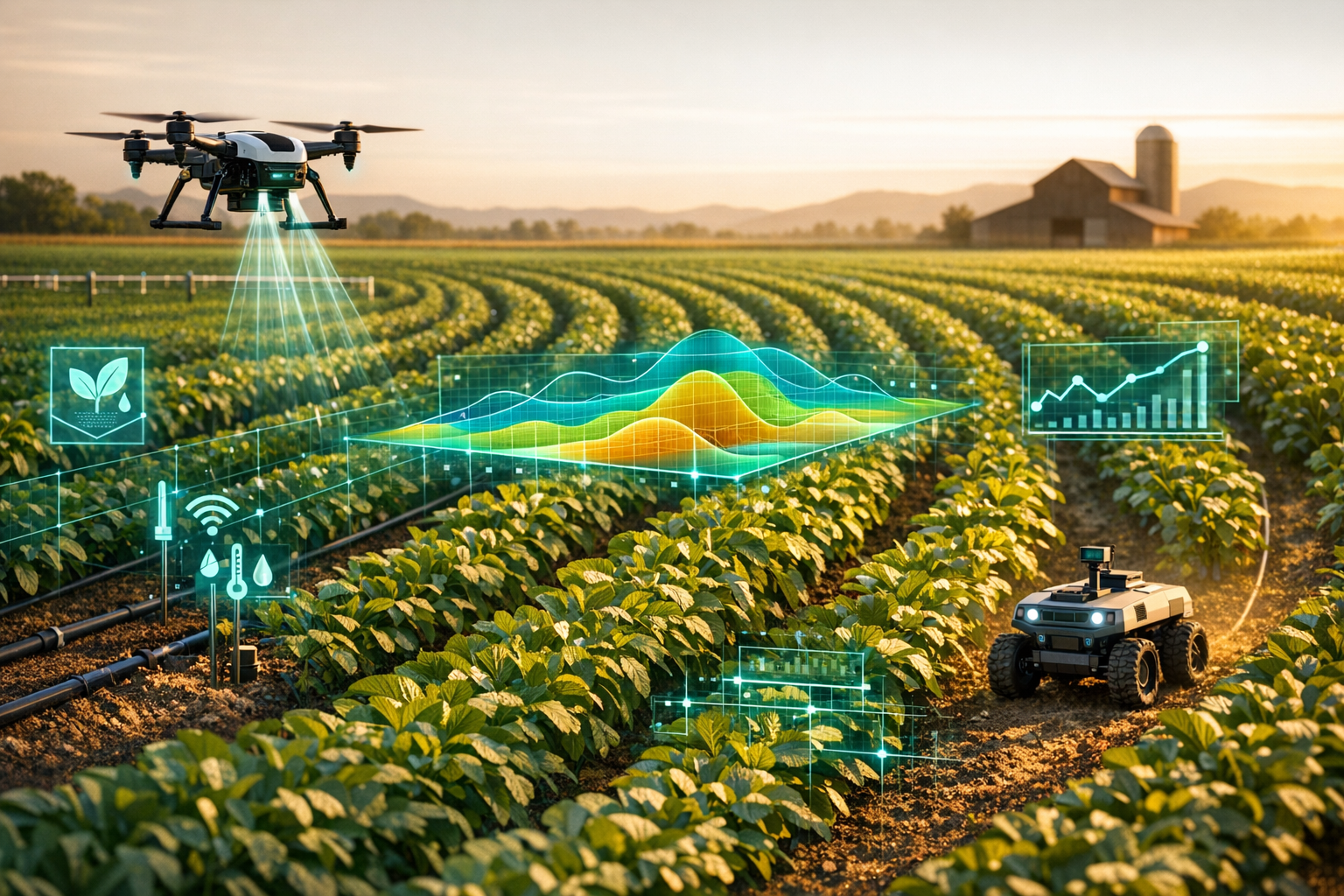
The first time I watched a farmer scroll through an app while standing in a muddy gateway, I did a double-take. Not because farmers can’t use phones (they can run circles around most of us), but because the screen was showing a patchwork map of his fields—green, amber, red—like some kind of weather radar for plants.
He didn’t look impressed. He looked… suspicious. “This corner always struggles,” he said, stabbing a finger at a red blotch. “If your app’s just telling me what I already know, I’m not paying for it.” Fair.
That’s the bar for AI in agriculture apps, by the way. Not “cool tech”. Not “machine learning”. It has to earn its keep—by saving time, cutting inputs, or nudging yields up without adding hassle. Otherwise it’s just another icon on a phone that gets ignored during lambing.
What “AI in agriculture” actually means on a Tuesday morning
AI in agriculture gets talked about like it’s a single thing. It isn’t. In practice, it’s a bunch of small, useful predictions and automations stitched into a workflow that already exists.
Precision farming is the obvious one: using field data to treat different parts of the same field differently—variable rate fertiliser, targeted spraying, smarter irrigation. Predictive analytics is the quieter cousin: “If you plant this variety next week, with this soil moisture trend, here’s your risk profile.”
If you’re building an agriculture app (or improving one), the question isn’t “Where can we add AI?” It’s “Where are people bleeding money or time—and can data help stop it?”
Because the farmer isn’t buying AI. They’re buying fewer wasted passes, fewer surprises, and fewer arguments with the bank manager.
Start with the decisions farmers already make (not the data you wish you had)
Most ag apps fail in a very specific way: they begin with a data source and go hunting for a problem. Satellite imagery! Drone photos! Soil sensors! Then the product becomes a museum of charts that don’t change what anyone does.
Instead, pick a handful of recurring decisions and build backwards. Nitrogen timing. Spray windows. Replanting patches. Irrigation scheduling. Harvest prioritisation. Feed planning. Labour allocation. These are the moments where a good nudge can pay for the whole app.
When I’m scoping an AI feature, I like to ask one slightly annoying question: “What will the user do differently in the next 24 hours?” If the answer is vague—“They’ll have better visibility”—I get nervous.
Visibility is lovely. But actions pay bills.
A practical shortlist of AI use cases that actually ship
You don’t need to build a moonshot. You need a feature that survives real farms, real weather, and real connectivity. These are the AI in agriculture app ideas I see delivering value without requiring a research lab:
- Yield prediction using historical yields, weather, soil, and management records—useful for planning storage, logistics, and cashflow.
- Variable rate recommendations (fertiliser, seed, lime) based on zones—turn maps into prescriptions, not just pretty colours.
- Pest and disease risk alerts combining local weather, crop stage, and known pressure—timing matters more than perfect detection.
- Irrigation optimisation using evapotranspiration, soil moisture trends, and forecast confidence—especially when water is expensive.
- Weed detection from imagery—often as “likely hotspots” rather than pretending to be 100% sure.
- Equipment maintenance prediction using machine telemetry—downtime in season is brutal.
- Input reconciliation (what was applied vs planned) with anomaly detection—quietly catches costly mistakes.
Notice what’s missing: grand promises. Farmers don’t need grand. They need dependable.
The data reality: messy, partial, and still useful
Let’s be honest—agricultural data is a bit of a junk drawer. Some lives in spreadsheets. Some in the head of the farm manager. Some in machinery portals with passwords nobody remembers. And some… doesn’t exist yet.
That doesn’t mean you can’t build AI. It means you build for imperfect inputs. Your app should be helpful at 60% data completeness, and brilliant at 90%.
If you’re creating an app for your business, start with the data you can reliably access: field boundaries, crop type, basic operations logs, weather, and maybe NDVI imagery. Then design the product so additional data sources unlock better recommendations, not basic functionality.
People will tolerate setup if the payoff is immediate. They won’t tolerate setup as a leap of faith.
Data sources that tend to play nicely
In the real world, these are the sources that most often integrate without turning your team into full-time detectives:
- Weather APIs (forecast + historical) with location granularity that matches farm reality.
- Satellite imagery for vegetation indices—useful for zones, trends, and “something changed here”.
- Manual field notes done well—quick logging beats perfect logging.
- Soil maps and lab results—less frequent, but high value.
- Machine data when available—powerful, but integration varies wildly.
And yes, IoT sensors can be great. They can also become expensive paperweights if batteries die and nobody has time to babysit them. Build like that’s going to happen—because it will.
Designing the app so AI feels like help, not homework
Here’s a little secret: the best AI feature is often a sentence. Not a dashboard. Not a heatmap. A simple, timely message that makes someone pause and think, “Ah. That’s useful.”
Farmers are busy. Everyone’s busy. Your agriculture app UI should assume the user has one thumb free, glare on the screen, and a tractor bouncing them around like a cocktail shaker.
So when you add AI, focus on three things: clarity, confidence, and control.
- Clarity: “Spray risk is high tomorrow after 2pm due to wind.” Not “Model output: 0.78”.
- Confidence: Show uncertainty like an adult. “High / medium / low confidence” is fine. Pretending you’re certain is not.
- Control: Let users override, adjust, and add context. AI that can’t be challenged becomes ignored.
I’ve seen apps win trust simply by explaining why a recommendation was made in plain language. “Based on 14-day rainfall deficit and crop stage.” That’s it. No thesis.
Precision farming features that move the needle (and don’t annoy people)
Precision farming is where AI in agriculture apps can shine—if you respect the workflow. The goal isn’t to create more maps. It’s to reduce wasted inputs and lift the weaker parts of a field without over-feeding the strong bits.
The most practical pattern I’ve seen is: detect zones → suggest action → make it easy to execute. If your app stops at detection, you’ve built a “nice to know”. If you go all the way to execution—exportable prescriptions, compatible formats, clear instructions—you’ve built a tool.
Also, don’t underestimate the power of “good defaults”. Most users don’t want to tweak five sliders. They want to glance, agree, and move on.
Making variable rate feel safe
Variable rate can feel risky, especially if someone’s been burned by a dodgy map in the past. A few things help:
- Start with conservative recommendations and show the expected range of savings/yield impact.
- Allow side-by-side comparison with a flat rate plan—people need an anchor.
- Keep an audit trail: what was recommended, what was applied, and what happened.
- Support “trial strips” so users can test without betting the whole field.
It’s not glamorous. But it’s how you turn scepticism into habit.
Predictive analytics: the quiet money-saver
Predictive analytics in agriculture sounds fancy, but it often boils down to being slightly less surprised. And that’s valuable.
A good example is disease risk. You don’t need perfect leaf-level detection to help someone time a spray. If your app can say, “Conditions are lining up for pressure in the next 5 days—check these fields first,” you’ve saved scouting time and potentially prevented a bigger problem.
Another is harvest planning. If you can predict which blocks are likely to hit target moisture first, you can sequence labour, storage, and machinery. That’s not just efficiency—it’s stress reduction. Hard to put on a spreadsheet, but everyone feels it.
The trick is to keep predictions tied to actions. Forecasts without decisions are just weather chat.
What it takes to build (or upgrade) an AI agriculture app without losing your mind
If you’re building an app for your farm business, your co-op, your agronomy service, or your equipment brand, you’ll be tempted to do everything at once. Please don’t. I say that as someone who has absolutely tried to do everything at once… and then watched timelines melt.
Pick one narrow workflow and make it unreasonably good. One crop. One region. One decision. Ship it, learn from it, then expand.
Also: plan for offline and poor connectivity. Not as a “nice feature”. As a baseline. Caching maps, queueing uploads, and letting users log actions without signal—these things aren’t sexy, but they’re the difference between a product and a demo.
And treat model performance like a living thing. Weather shifts. Practices change. New varieties appear. Your AI needs monitoring, retraining, and a way to gracefully fail when it’s out of its depth.
A few build choices that pay off later
- Human-in-the-loop from day one: let agronomists and farmers correct outputs; those corrections become gold.
- Explainability as a product feature: not academic, just “what data influenced this?”
- Permissions and privacy done properly: farm data is sensitive; trust is slow to earn and fast to lose.
- Integration strategy: decide early which platforms you’ll connect to and which you won’t—otherwise you’ll drown in edge cases.
If you’re improving a current app, look for the screens people open the most. Add AI there, not in a new tab nobody visits. The best place for “smart” is right where the work already happens.
Cost cutting vs yield boosting: don’t force the choice
People talk like you either use AI to boost yields or cut costs. In reality, the same feature often does both—just at different times.
Variable rate nitrogen can reduce waste in high-performing zones and lift weaker areas. Better spray timing can reduce chemical use and avoid yield loss. Smarter irrigation can cut water and keep the crop out of stress.
But your app has to be honest about trade-offs. Sometimes the “cheapest” option increases risk. Sometimes the “highest yield” plan costs more than it returns. Give users a way to choose their preference—profit, risk, sustainability, simplicity—without shaming them.
Farms are businesses. They’re also homes. Reality is complicated.
The bit nobody wants to say out loud
AI in agriculture isn’t magic. It’s pattern recognition plus decent product design plus a lot of respect for the people using it.
If you build an agriculture app that helps someone make one better decision a week—one less wasted pass, one earlier warning, one patch fixed before it spreads—you’ll do more for “digital transformation” than a thousand glossy decks ever will.
And if you’re sitting there thinking, “I’m not sure we can pull this off”… yeah. Same. That feeling never fully goes away.
You just build the next useful thing, test it in the mud, and let the results do the talking.